

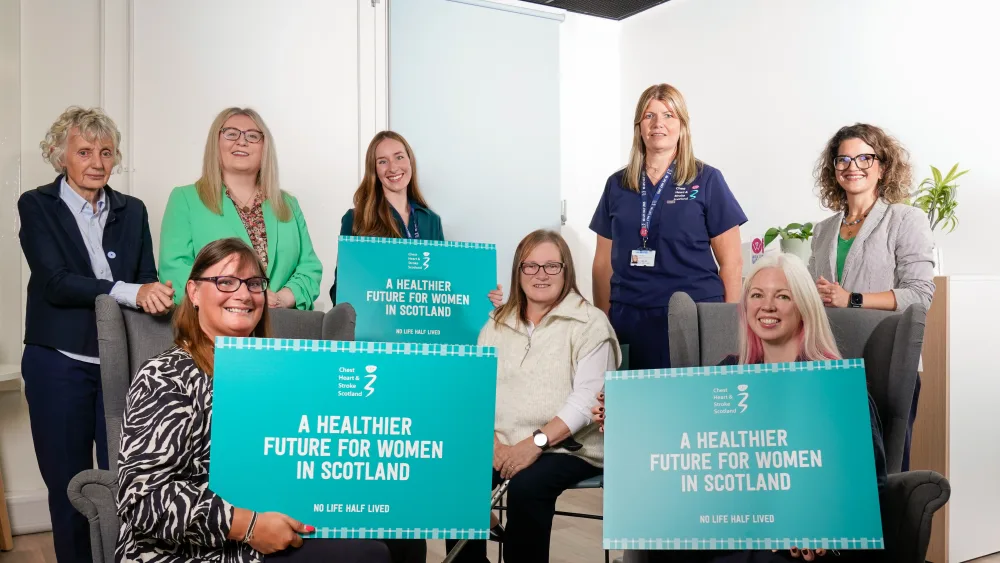
Women in Scotland are suffering avoidable deaths because of barriers to accessing healthcare for chest, heart, stroke and other long-term conditions, a health charity has said.
Chest Heart and Stroke Scotland (CHSS) has highlighted figures that have shown women in Scotland are 50% more likely than men to receive an initial misdiagnosis after a heart attack.
The charity claimed that across the UK, women are twice as likely to be misdiagnosed with heart failure, with many waiting an average of 20 weeks for a diagnosis compared with just 3.6 weeks for men.
CHSS also said women are less likely to be offered diagnostic testing within 72 hours of a heart attack and less likely to be prescribed medication that reduces the risk of a second one.
Additionally, the charity highlighted that women are nearly twice as likely to die from asthma than men, despite asthma and chronic obstructive pulmonary disease (COPD) being more common in women.
CHSS has said the consequences are apparent, as UK female life expectancy has fallen from 20th to 26th place out of 38 OECD (Organisation for Economic Co-operation and Development) countries in recent years.
In response, CHSS has launched a three-year Women’s Health Plan to tackle inequalities in long-term conditions for women.
“Women have been telling us for years that their symptoms aren’t being taken seriously, and the evidence backs them up,” said Jane-Claire Judson, chief executive of Chest Heart and Stroke Scotland.
“When we talk about women’s health, we need to look beyond reproductive and maternal health alone. Women experience inequalities across a wide range of conditions, including chest, heart, stroke and long Covid conditions, and they deserve equitable access to the information, support and care they need.”
CHSS’s new action plan sets out seven commitments to improve prevention, diagnosis, treatment and support for women across Scotland:
– Developing clear, women-specific health information.
– Raising the visibility of women’s health through targeted campaigns and storytelling.
– Launching a dedicated prevention and early detection programme through CHSS’s Health Defence and Community Healthcare Support Service.
– Strengthening training on women’s health for healthcare professionals, CHSS colleagues and volunteers.
– Expanding peer support and post-diagnosis care for women.
– Campaigning for better policy, funding and women’s inclusion in research.
– Driving continuous improvement of CHSS women’s health work shaped by lived experience.
Ms Judson said the plan is about listening to women’s experiences and turning them into meaningful action.
“By improving awareness, supporting earlier detection and diagnosis, and ensuring women are heard when they seek help, we can begin to address inequalities that have persisted for far too long,” she said.
Sylvia Adams, 60, from Aberdeenshire, volunteers in CHSS’s Women’s Health Steering Group, and helped to shape the charity’s action plan.
“I didn’t really realise how disadvantaged women were when it came to health, and I don’t think I’m alone in that,” Ms Adams said.
“You just make the assumption you’ll be treated the same as anyone else when you ask for help or advice, which is clearly not the case. The statistics prove it.
“If you as a mother, wife or sister aren’t able to look after yourself, it doesn’t serve anybody. Self-care isn’t selfish.”
Professor Anna Glasier, women’s health champion for the Scottish Government, has “whole-heartedly” welcomed the publication of CHSS’s Women’s Health Plan 2026-2029.
She said the plan sets out clearly the burden of cardiovascular and respiratory disease among women in Scotland and highlights the “stark reality of the gender inequity”.
“The most eye-catching is the aim to develop a women-specific prevention and early detection programme as well as continuing to provide support for women diagnosed with cardiovascular or respiratory disease,” Professor Glasier said.
“Equally important is the commitment to improving information and awareness for women, and supporting education and training for healthcare professionals, ambitions which align closely with the aims of the Scottish Government’s Women’s Health Plan Phase 2.”
CHSS is encouraging people across Scotland to support the movement for better women’s health by reading and sharing the CHSS Women’s Health Plan, and raising awareness of signs and symptoms of chest, heart, stroke, and long Covid conditions in women.
The charity plans to work alongside women, healthcare professionals, community partners and policymakers to ensure women’s health continues to be a national priority.