

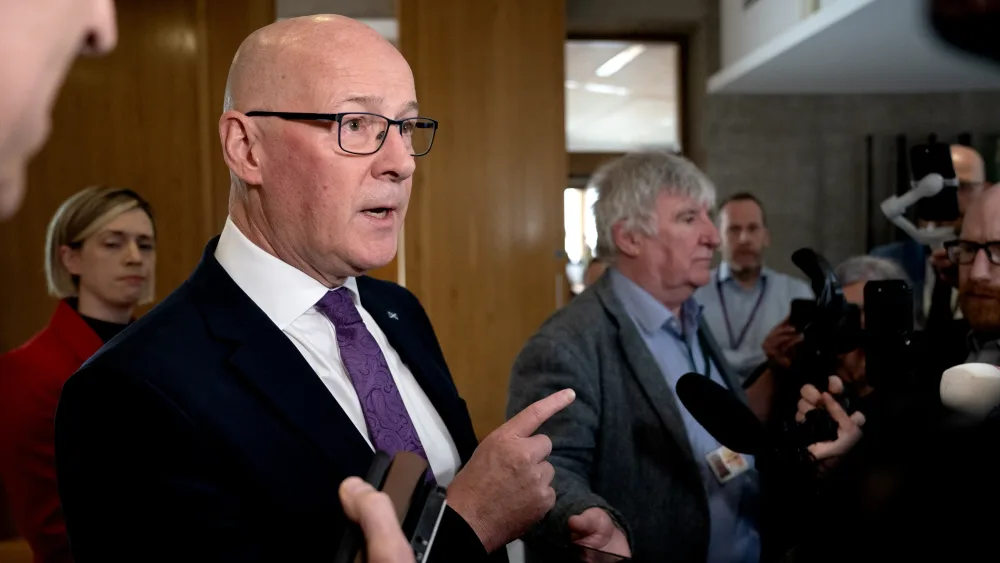
John Swinney made a fresh plea for powers over energy to be transferred to Scotland – with the Scottish First Minister insisting this would show if Westminster is “serious” on further devolution.
The SNP leader spoke out after Britain’s likely next prime minister Andy Burnham promised there would be “new opportunities to extend devolution in Scotland, Wales and Northern Ireland”.
Mr Swinney said: “If the UK Government was serious about devolving more power away from Westminster, they would finally put control of Scotland’s energy resources in Scotland’s hands.”
His comments came ahead of the energy price cap rising by 13% on Wednesday – with Mr Swinney adding that “the prospect of further energy bill increases will be causing anxiety for many people who are already struggling with the cost of living”.
Scotland is an energy-rich country, so nobody should be struggling to pay their bills
The Scottish Government has a “number of measures” in place to help those facing difficulties as a result of rising fuel prices, he said, with the First Minister urging people to check if they are eligible for support.
He condemned the UK Government, saying Labour had come to power in 2024 “promising to cut people’s bills by £300, yet they are soaring higher and higher”.
Mr Swinney insisted: “It is simply not good enough.
“It does not need to be like this. Scotland is an energy-rich country, so nobody should be struggling to pay their bills.”
His comments came as a UK Government study showed “high potential” for nuclear power in Scotland – something SNP ministers are firmly against.
UK Energy Secretary Ed Miliband commissioned a technical study to examine potential areas which could be suitable to new nuclear developments in the future, ranging from small modular reactors to large-scale power stations.
This identified three sites already linked with nuclear power – Torness in East Lothian, Dounreay in the Highlands and Hunterston in North Ayrshire – along with potential areas for developments in the Firth of Forth estuary and the eastern coast of Scotland.

UK energy minister Michael Shanks said: “This new report shows there is potential for new nuclear in Scotland which could boost the country’s energy security and deliver new jobs.”
He added: “We are delivering a golden age of nuclear in England and Wales from Sizewell C to small modular reactors.
“Sadly, Scotland is missing out on the enormous economic and energy security potential.”
Tom Greatrex, chief executive at the Nuclear Industry Association, said: “Scotland has the sites, skills and decades of engineering expertise for new nuclear projects, alongside strong community support.
“Scotland deserves the same investment and opportunities that are going into new nuclear in England and Wales.
“It’s time for a new dialogue about energy policy and a robust, diverse mix of clean power sources.
“New nuclear in Scotland can play a key part in that and unlock new investment that strengthens energy security, supports local communities, and creates thousands of jobs.”

The report was published as separate figures showed renewables generated a record amount of electricity in the first three months of this year.
A total of 13.4 terawatt hours (TWh) of power was produced, a rise of 22% on the previous three months.
Mr Swinney said: “Our future lies in clean, affordable and secure power – strengthening affordability, resilience and competitiveness, and protecting people and businesses from their energy bills being dictated by international events.
“That is why powers over Scotland’s energy must be in Scotland’s hands, so we can make our vast energy wealth work for us and bring down bills.”
Scottish Government energy minister Stephen Gethins said Scotland’s “abundant renewable resources” could help reduce the country’s reliance on “volatile global energy markets”.
Adding that Scotland was a “massive energy exporter”, he said the country “also has a critical role to play in safeguarding UK and European energy security”.
Mr Gethins added: “That’s why the Scottish Government will continue to accelerate investment in renewables to strengthen our energy security, produce the power we need to meet increasing demand and support progress towards net zero.”