

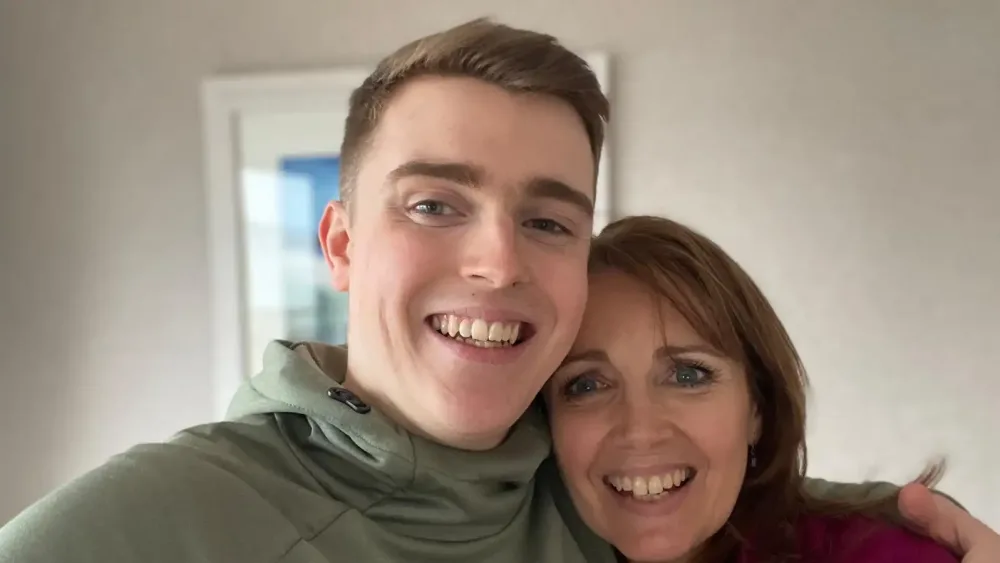
A mother who feared her student son may not survive as he battled meningitis B has urged young people to take up the offer of vaccination against it.
Gaynor Simpson’s son Ross became critically ill with meningitis aged 18 in 2023 while in his first year at the University of Glasgow.
He spent five days on life support at the Queen Elizabeth University Hospital in Glasgow and his family were warned he might not survive, but went on to recover.
The MenB vaccine, which helps to protect against meningitis and sepsis caused by meningococcal group B bacteria, is now being offered to young people in clinics across Scotland.
It quickly escalated into a situation where it was unclear whether or not he would survive
The vaccination programme was announced by UK authorities last month after a series of recent meningitis outbreaks, the most serious of which was in Kent, England and left two teenagers dead.
Mrs Simpson, who lives in the Glasgow area, said: “Ross became critically unwell after just feeling a bit under the weather. It quickly escalated into a situation where it was unclear whether or not he would survive.
“To see your healthy, thriving 18-year-old child go from feeling a bit off colour to fighting for his life in ICU within the space of a few hours is a feeling that we, as parents, will never forget.
“We are immensely grateful that despite the severity of the infection, he is still with us.
“It is a very long road to recovery from meningococcal disease and as we have seen from recent outbreaks in the UK, others are not so lucky.
“It is a cruel and unforgiving disease that takes effect at terrifying speed.
“Given our experience, I can’t stress enough to young people and to their parents how important it is to take up the full two-dose offer of the MenB vaccine. It could save your child’s life.”
The vaccination programme aims to protect young people who are at higher risk of infection, especially those who are preparing to start university or college in the 2026/27 academic year, where close contact and shared living arrangements can increase the risk of meningococcal disease.
In Scotland the MenB vaccine is being offered to young people born between 1 March 2008 and 28 February 2009, and any others who were in S6 during the 2025-26 academic year, regardless of future education plans.
It is also being offered to undergraduate university entrants under the age of 25 who are starting for the first time in the academic year 2026-27, including international students, and to college entrants under 25 starting for the first time in the academic year 2026-27 while living away from home in shared student accommodation, including international students.
Describing her son’s experience to the Press Association earlier this year, Mrs Simpson said: “He was on life support for five days. The first three of those days were the days where we just we didn’t know.
“We were told it’s very possible that he will not make this, he was that ill.
“He did pull through, he started to turn the corner thankfully, and he was in intensive care in total for 10 days, and then came home to start the long road to recovery.”
Authorities said it is essential to receive two doses of the MenB vaccine, at least 28 days apart, for full protection.
Both doses should ideally be completed before starting college or university.
Dr Sam Ghebrehewet, head of vaccination and immunisation at Public Health Scotland, said: “Immunisation is the most effective way of preventing illness from meningococcal disease.
“The roll out of the MenB vaccination programme is an opportunity for all eligible young people to receive vital protection from such a serious and life-threatening disease.
“We encourage all those who are eligible to take up the offer, and to ensure both doses are received for full protection.”
The vaccine is also being offered to young people in other parts of the UK.
The menB vaccine was introduced on the NHS for babies in 2015 but children born before then have not been vaccinated on the health service.
Teenagers in school are currently offered the MenACWY vaccine, a single dose jab that protects against four strains of meningococcal bacteria and was also introduced in 2015.