

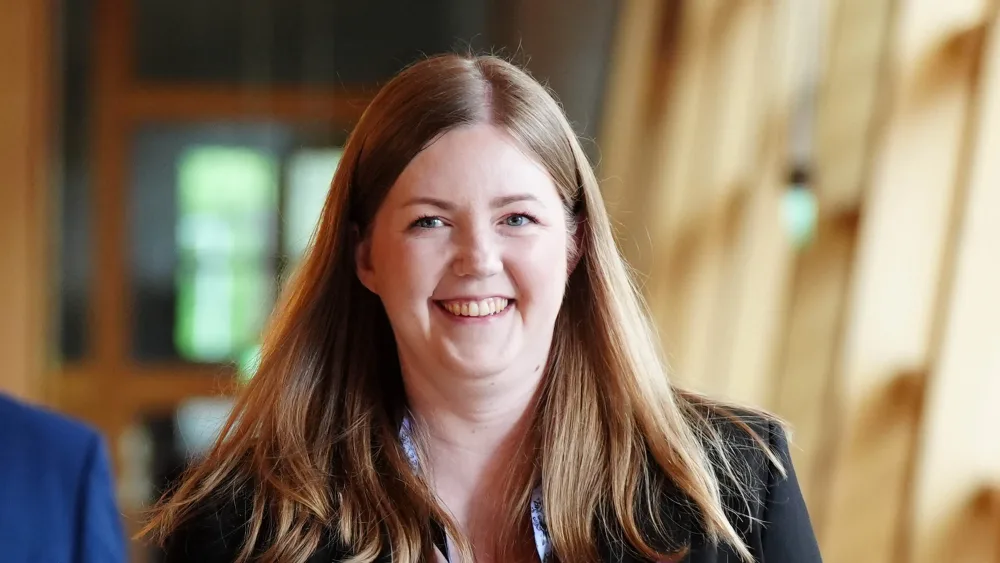
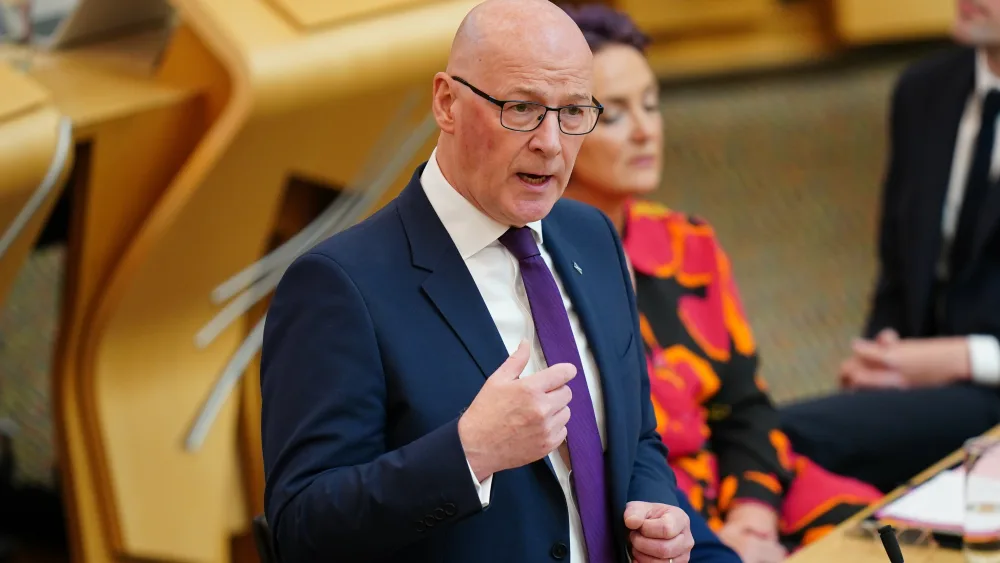
John Swinney should tax the wealthy in Scotland instead of axing public sector jobs, the Scottish Greens have said.
Co-leader Gillian Mackay warned the Government’s focus on “public sector reform” would likely mean slashing budgets and cutting jobs.
Speaking during the inaugural First Minister’s Questions since the election, she urged the First Minister to agree to a bigger roll-out of a four-day work week for public workers.
She also called on the SNP leader to work with her party to reform council tax – something long promised but not delivered by the SNP.
Ms Mackay said: “We know public sector reform is badly needed, but trade unions in particular are rightly concerned that reform is usually a euphemism for slashing budgets and cutting jobs.”
Ms Mackay said more money had to be raised from the “super rich” in Scotland and urged the First Minister to “explore all options for taxing wealth before cutting public sector jobs”.
She asked the FM to back calls from Tax Justice Scotland to replace council tax by 2031 “at the latest”.
The group, which brings together more than 50 organisations campaigning for tax reforms, also wants the Scottish Government to make faster progress on introducing a new levy on private jets.
It made the demands in an open letter to the First Minister, with campaigners arguing “bold steps towards tax justice” could help provide funds to reduce inequality, invest in public services and tackle climate change.

Ms Mackay said reforms should include a widening of the four-day work week, which she said would decrease mental health sick days and boost productivity “at no extra cost to the public purse”.
Mr Swinney said he was open to reforming or even abolishing council tax in Scotland but the Government had to have “reliable means” in place to fund public services.
On reform, the First Minister said while he understood concerns from trade unions, Scotland had “to be open to new ways of delivering public services”, saying Holyrood had to be a “bold” Parliament.
He said Ivan McKee, Public Service Reform Secretary, would look to improve public services while making the Government’s finances more sustainable, suggesting services could be delivered better while costing less.
He added: “Of course, without a majority in this Parliament, the Government is going to have to work with others to come to common positions, and I look forward to taking those discussions forward with many colleagues across the political spectrum.”
He went on: “I do think there is a deadly serious point at the heart of the question, which is the environment in which public servants are working really matters, and if that environment is essentially burdened by excessive bureaucracy or by slowness in decision making, then that can obviously have a negative effect on individuals in carrying out their responsibilities, and those considerations are at the heart of what Ivan McKee is looking at.
“To make sure that we utilise to the maximum the effectiveness of public expenditure, so that public servants are able to fulfil their roles, and also that we are able to deliver better outcomes for members of the public in Scotland.”
Jamie Livingstone, the head of Oxfam Scotland, and a member of Tax Justice Scotland, said earlier that Scotland had to urgently “start taxing wealth properly to help fund the fairer future people were promised”.
“In Scotland, that starts with replacing council tax and fast-tracking a tough tax on the wealthy private jet passengers polluting our skies.”
Tax Justice Scotland insisted that existing plans from the Scottish Government to bring in two new council tax bands for properties worth £1 million and more – a so-called “mansion tax” – are not a “substitute for fundamental reform”.
The group, therefore, called on the First Minister to “announce an immediate revaluation of properties”, as well as “a time-bound process to replace council tax”, which it said should be “implemented by 2031 at the latest”.
Adding that 83% of Scots back a “fairer system”, the letter called on the First Minister to “provide the political leadership needed to deliver it”.
They said Mr Swinney could “make the creation of a fairer system a key legacy of this Parliament”.